Concept
CONCEPT
Hard Wallonia Tour 2026 (HWT 2026) – Event Description and Rules
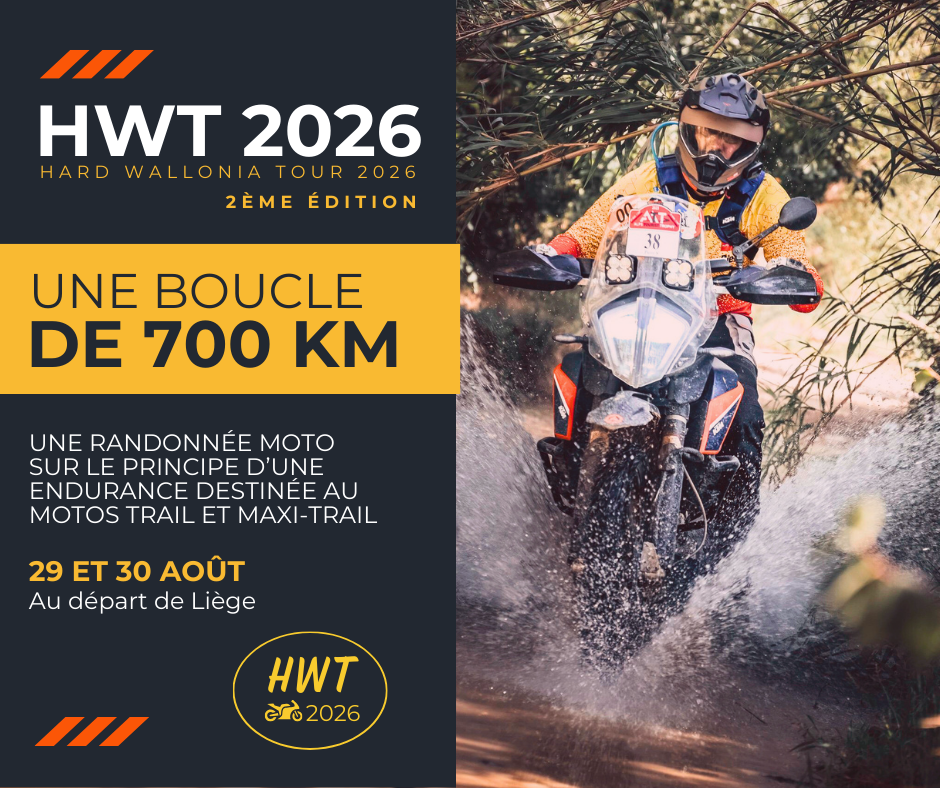
The goal of the Hard Wallonia Tour 2026 (HWT 2026) is to offer a TRAIL motorcycle tour in the form of endurance and navigation, allowing participants to discover a region in a different way, at a relaxed pace, on motorcycles (trails/maxi-trails), while testing their endurance limits and night off-road riding skills.
This is not a competition, and therefore no ranking will be established.
The event will take place on Saturday, August 29, and Sunday, August 30, 2026.
The objective is to complete a loop of approximately 700 km starting and ending in Liège within 24 hours, starting Saturday early afternoon and following a predefined route.
This includes riding off-road at night.
Only motorcycles of the TRAIL or MAXI-TRAIL type equipped with knobby tires will be accepted. ENDURO motorcycles are not permitted unless they are fully street-legal (lights, indicators, mirrors) and ridden by women.
A minimum off-road range of 200 km is recommended. Fuel stations are available approximately every 200 km along the route.
Participants are covered by their personal insurance, and each participant must comply with the Highway Code as well as the Forest Code.
A fully verified and approved GPX track will be provided by email to each participant no later than 30 minutes before their start time (participants will depart one by one at one-minute intervals).
Participants must be self-sufficient and able to navigate independently using their personal GPS device (either a GPS capable of loading a precise track, or a smartphone/tablet running software like Osmand or GuruMaps). No TRIPY files will be provided.
Each participant is free to personalize their tour, either by modifying it or taking the most direct paved road to finish faster or more easily. There is no obligation to follow the GPX track from start to finish.
However, the title of “FINISHER” is awarded only to participants who ride the entire GPX track (you may temporarily leave the track but must return at the point where you left) and complete the loop within the 24-hour time limit.
The organizer has made every effort to comply with applicable rules when designing the route. Nevertheless, interpretations may vary, and last-minute changes may occur. In case of unexpected road closures, the route-opening team will provide detour signage.
If a participant considers the proposed track to violate regulations or finds it technically too difficult, it is their sole responsibility whether or not to follow it. The organizer cannot be held responsible for any participant’s choices or actions and their consequences.
Since the route includes public roads, motorcycles must be fully compliant with legal regulations and equipped with knobby tires. In the case of a serious technical fault (defective brakes, broken indicators, oil leaks, exhaust without DB Killer, “junk” bike, etc.), the organizer reserves the right not to allow the participant to start.
As motorized touring is increasingly under threat, participants are asked to moderate their speed according to the following recommendations:
Crossing farms or near pedestrians: max 10 km/h
Passing cyclists: stop to allow them to continue without interruption
Passing or crossing horses: stop with engine off
Villages or isolated houses: be as discreet as possible
Paved roads: strict compliance with the Highway Code
The GPX track has been designed to offer a variety of terrain: fast and slow sections, dry and muddy, technical climbs and descents, wide open paths, single-tracks, slippery grassy sections, ruts, water crossings, and more.
There are no insurmountable obstacles for a TRAIL or MAXI-TRAIL bike. However, riding a maxi-trail on this route is not recommended without off-road experience. Light trail bikes are suitable even for beginners.
Participants must adapt their riding to ensure safety and enjoyment. To continue practicing motorized touring, one rule applies: “Share the trails kindly with other users!”
Assistance
In case of a flat tire, mechanical breakdown, or failure, priority must be given to mutual assistance among participants.
If mutual help or improvisation does not resolve the problem, the organization can assist only by transporting the participant and their motorcycle back to the starting point.
Important: The motorcycle must be brought off the trail and onto paved roads to receive assistance.
The organization does not cover fuel shortages; each participant must plan accordingly.
The organizer cannot be held responsible for any damage following assistance.
In case of a fall or concern for a participant’s physical integrity, the participant or other riders should call 112 and notify the organizer.